a story app about the brain and nervous system, for iPhone, iPad and Android. follow one pain signal from a nerve ending in the toe to the spinal cord to the cortex, and keep every neuron, synapse and brain structure you meet as a 3D specimen, with a card that names its source.
Chapter I free · Complete Edition, one purchase · iphone, ipad & android · no account
the trailer · the app's own scenes, read by its narrator · 1:19 · captions
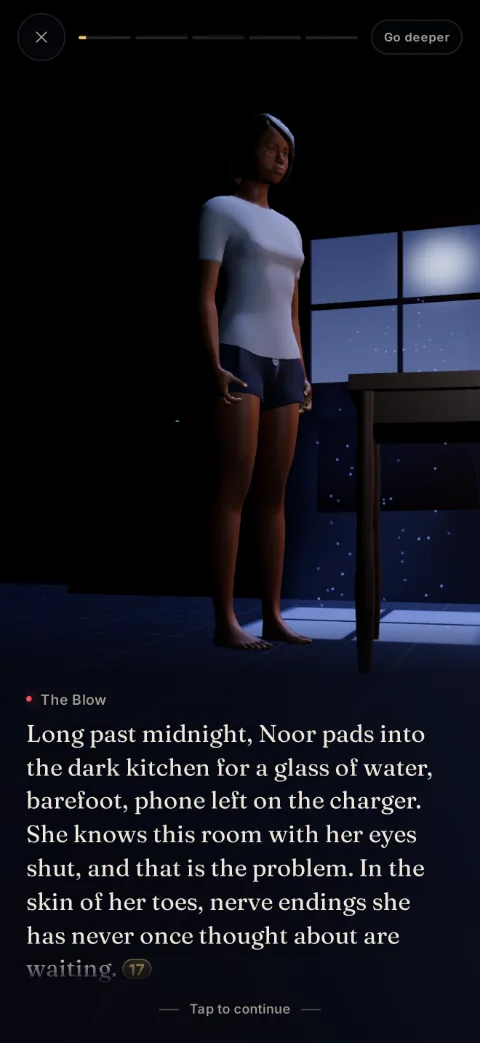
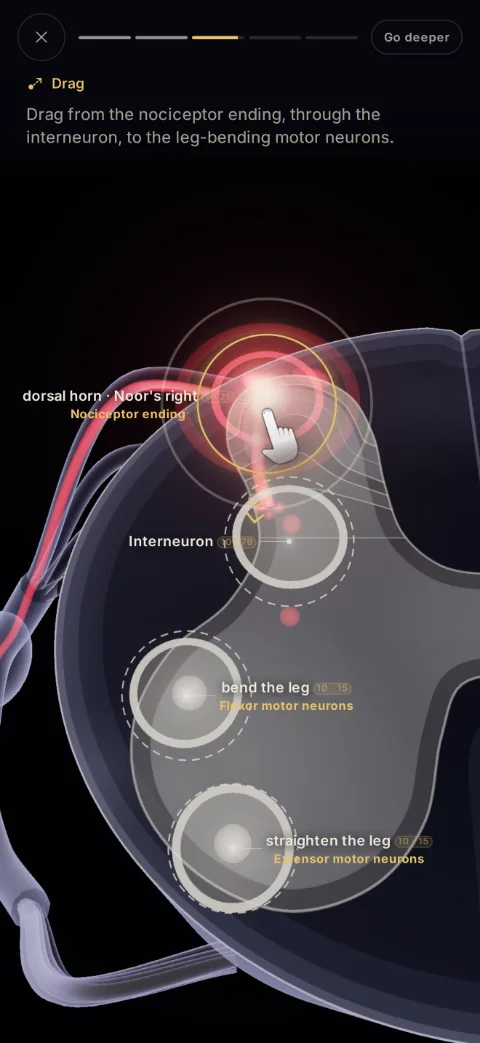
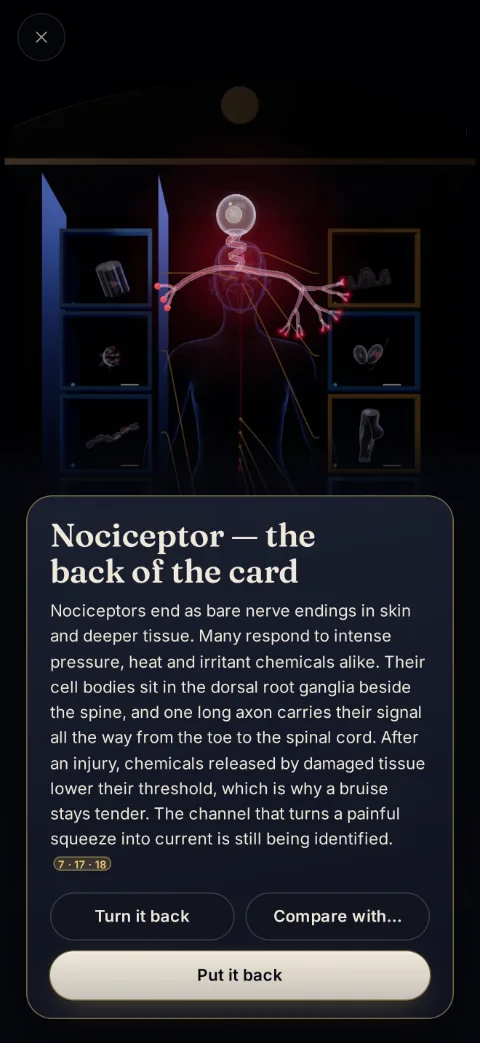
a story you play
long past midnight, Noor stubs her toe on the table leg. for a sliver of a second, nothing hurts at all. each chapter is one moment in her life, told from inside her nervous system.
you don’t watch the signal travel. you carry it: hold a nerve ending until it reaches threshold, tap to catch the sodium channels opening, race a fast fiber against a slow one, and drag the reflex through the spinal cord to the muscles that bend her leg.
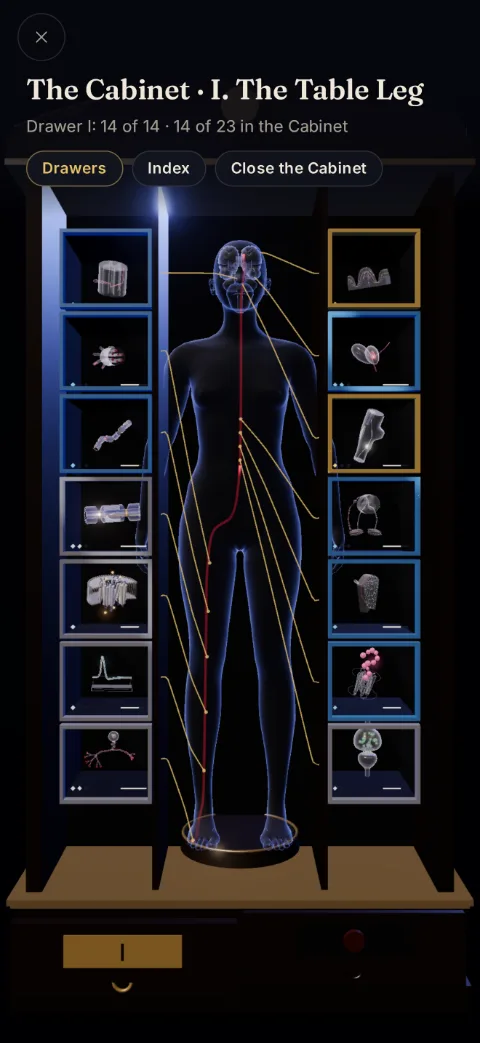
a cabinet of specimens
every neuron, synapse, pathway and brain structure you meet becomes a specimen in your Cabinet: a 3D object in its own drawer, with a card that explains it. specimens move from encountered to understood to mastered as you play and recall them.
while you’re away, Noor sleeps. in sleep, the hippocampus replays recent experience, and researchers think this replay helps memories last. when you come back, a short recall round brings back the specimens that have faded. recall is capped each day, and a missed day never leaves a pile of overdue cards.
every claim has a source
the science comes from peer-reviewed research and standard neuroscience textbooks. turn any card over to see the research behind it. where the story simplifies something, the app says what it simplified and why, and it doesn’t call anything settled while researchers still disagree.
the five chapters
- I. The Table Legfree
pain: nociceptors, the action potential, voltage-gated sodium channels, myelin, A-delta and C fibers, glutamate and substance P, the dorsal horn, the withdrawal reflex, the spinothalamic tract, the thalamus, the somatosensory cortex and the brain’s own pain control. it ends with a clinical what-if: diabetic neuropathy.
- II. The Near MissComplete Edition
fear and stress, as a car door opens in front of Noor’s bike: the amygdala’s fast route, the locus coeruleus, the hypothalamus, the sympathetic nervous system and adrenaline, the HPA axis and cortisol, the prefrontal cortex and emotional memory. its what-if: fear that doesn’t fade (PTSD).
- III. The First SongComplete Edition
learning a motor skill, as Noor learns Teta’s melody on the piano: the motor cortex, the corticospinal tract, the cerebellum and Purkinje cells, the basal ganglia, dopamine and reward prediction error, NMDA receptors, LTP and LTD, and sleep. its what-if: Parkinson’s disease.
- IV. The Smell of CardamomComplete Edition
smell and memory, as a jar of cardamom brings back Teta’s kitchen: olfactory receptor neurons, glomeruli, the piriform cortex, the hippocampus and place cells, engrams, systems consolidation and reconsolidation. its what-if: the loss of smell.
- V. Sami ForgetsComplete Edition
ageing and Alzheimer’s disease, as Noor’s grandfather Sami loses what happened an hour ago: the entorhinal cortex, amyloid plaques, tau tangles, Braak stages, synapse loss, microglia and procedural memory, including what is known and what isn’t. its what-if: looking for Alzheimer’s early.
coming to the complete edition
five more chapters are being made. they aren’t in the app yet and have no release dates. each one arrives as a free update for everyone who owns the Complete Edition.
- VI. The Buttoncoming
pain relief, opioids and addiction.
- VII. The Red-Eyecoming
the body clock and sleep.
- VIII. The Cupcoming
stroke, language and recovery.
- IX. The Dabkecoming
hearing, balance and movement.
- X. The Walk to the Seacoming
depression and its treatment.
who it’s for
students of psychology, biology, physiology, anatomy, nursing and pre-med who want to see how the nervous system works rather than memorize a diagram of it, and anyone curious about what happens inside them when they stub a toe or get a fright.
free to start, one purchase for the rest
Chapter I is free and stays free, including its specimens and their recall. the Complete Edition is a single in-app purchase: it opens Chapters II to V now, and Chapters VI to X as free updates when each is released. no subscription, no ads, no account. Family Sharing is supported on the App Store.
made with care
- works fully offline
- collects no data: no analytics, no tracking
- follows your device’s reduce-motion setting
- sound and haptics can each be turned off
Animated Neuroscience is a study companion and a story. it isn’t exam prep, it isn’t a medical device, it doesn’t diagnose or treat anything, and it isn’t brain training. it explains how your nervous system works.